
Moorland Wildflower Calendar: What to Look For Month by Month
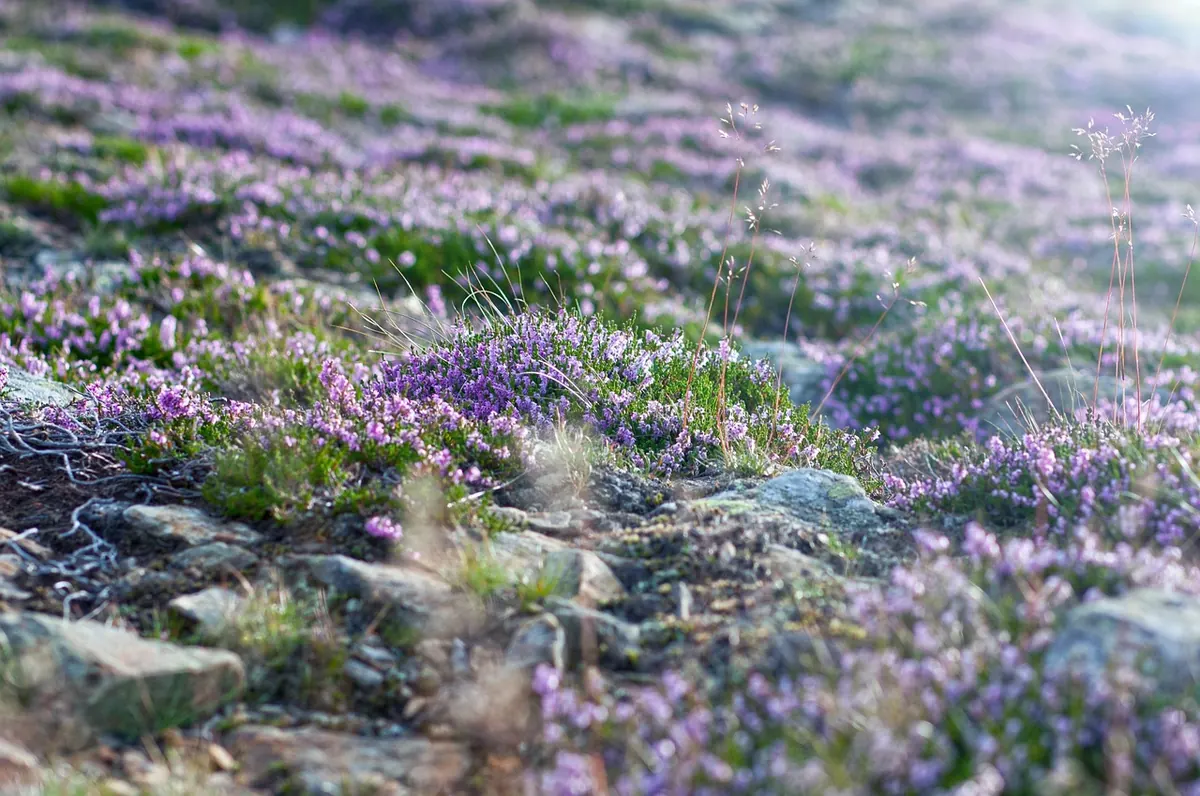
From a car window in February, a moor looks like one colour: wet grey. Walk ten minutes off the road, though, and the calendar starts to show itself. Bog moss glows green in a drainage grip, a first coltsfoot opens on a spoil heap, and under the heather the year's buds are already set. What follows is a rough running order for the moorland year, with notes on where each species turns up and how to look without leaving a mark.
Treat it as a framework rather than a fixed timetable. Altitude moves everything on by two or three weeks; a north-facing gully at 500 metres may be a full month behind a sunny verge at 200. Latitude matters too, and so does the season itself — an early spring on the west coast of Scotland is not an early spring in the North York Moors. Use the months as a guide, then let the ground correct you.
January to March: Reading the Bare Ground
This is identification-by-skeleton season, and it is more useful than it sounds. With nothing in flower, you learn the shape of the place: which slopes drain, where the peat hags sit, which hollows hold water into spring.
Gorse, or whin as it is called across the north and west, carries yellow flowers through almost any mild spell, and on a still day you often smell the coconut scent before you see the bush. Ling holds its pale seed heads all winter, grey-white against black peat, and this is the easiest time to sort your heathers by leaf. Ling's leaves are tiny and scale-like; cross-leaved heath has grey-green leaves in whorls of four up the stem.
Learn the ground layer now and you will read the summer far faster. Bog mosses — the sphagna — look like nothing much until you get down with a hand lens, when the difference between a red-tipped bog moss and a golden one becomes obvious. The same goes for the grey-green tufts of deer grass and the stiff, bristly clumps of purple moor-grass, both of which define whole square kilometres of moor and barely register in July, when everything is tall.
Real colour returns in March, in the sheltered places first: coltsfoot on bare, disturbed ground, lesser celandine where a clough opens into woodland, opposite-leaved golden saxifrage in wet ditches. On the highest mountain ledges, purple saxifrage can be out before the last snow has gone.
Two cautions for these months. After winter rain the peat is at its most fragile, so stay on established paths across open bog. And the sphagnum mosses are vivid now, worth ten minutes with a hand lens. They are the reason the bog exists at all.
The moor is never empty in winter. It is only quiet, and quiet takes practice to read.
April and May: The Early Risers
April brings the first flowers people travel for. Bilberry blooms in April and May, and it is easy to walk straight past: the flowers are small, globular, greenish-pink bells hanging under the twiggy growth, best found by looking down rather than ahead. Where bilberry runs in sheets across a heather slope, the green hairstreak butterfly often follows, and it is worth watching the bushes rather than the sky.
On the wet ground, marsh marigold lights up flushes and ditch edges with a yellow that reads as almost unnatural against black peat. Lousewort appears in the same damp places, its pink flowers a reliable marker for ground that stays wet all year. Then there is butterwort, which most people mistake for a small yellow violet until they notice the pale-green rosette of leaves beneath, sticky and faintly greasy to the touch — a plant that eats insects because the bog gives it so little.
May is when the moor starts to hum. Common cotton-grass sends up its white head, and the first waves of it across a bog are one of the great sights of the uplands, even though the "cotton" is a seed tuft rather than a flower. Wood anemone and early purple orchid appear where heath meets woodland edge.
One important caution for these two months: this is peak nesting season. Curlew, lapwing, golden plover and dunlin all nest on open ground, and their eggs and chicks are near-invisible. Keep to paths, keep dogs on leads, and if a bird starts calling and circling, you are too close — back off the way you came.
June and July: The Peak Months
By June, the moor has stopped being a place you scan and become a place you sit down in. Cross-leaved heath opens first, then bell heather, both carrying the pink-purple tones that people lump together as "heather". The difference is worth knowing: bell heather flowers earlier, in looser spikes, and cross-leaved heath holds its flowers at the tips of tall stems above those whorled leaves.
Bog asphodel is the star of the wet ground, its spikes of yellow stars turning orange as they age. Sundew appears on bare peat and in the hollows between hummocks — round-leaved sundew most often, each leaf a tiny red pin-cushion of glistening droplets. It is small enough that you will only see it by crouching, which is no bad thing.
Higher up, cloudberry flowers in June, with a single white flower on each stem, and it is one of the few true Arctic-alpines you can find on a British moor. Look for it on the high, wind-scoured plateaus rather than in the valley bogs. Add to the list heath spotted orchid, heath milkwort in blue, pink and white on the same slope, and bogbean fringing the open water.
August and September: The Purple Peak
Ling comes into flower in late July and carries the moor through August. The effect is a slow wash of colour rather than an instant change, and it lands best on dull, humid days when the scent sits low over the slope. Purple moor-grass waves through the same weeks, its feathery heads catching the light.
This is also the fruiting season. Bilberry berries darken under the leaves, crowberry and cowberry follow, and if you are on the right slope you will smell bog myrtle before you find it — a sweet, resinous scent that some people liken to a warm gin and tonic. Devil's-bit scabious opens towards the end of the run, its tight blue-violet pincushions feeding late bees and butterflies long after most of the moor has gone over.
October to December: The Slow Fade
Autumn is underrated on moorland. Grass-of-Parnassus and autumn hawkbit hold on into October in the wet flushes, and the seed heads take over from the flowers: cotton-grass again, hare's-tail, the papery remains of bog asphodel standing rusty above the moss.
Waxcap fungi push up through short turf from September onwards, some of them startlingly bright — yellow, orange, even a glossy green. They are a reminder that half the life of a moor is below the surface. By November, the last colour has usually gone from the flowering plants, and the mosses take the stage again, just as they did in January.
How to Look Without Leaving a Mark
Moorland plants are tough in the long run and fragile in the short. A few habits make the difference between a good visit and a damaging one:
- Stay on the path across open bog. Sphagnum grows a millimetre or so a year, and a boot print can stay visible for decades.
- Never dig up a plant. Orchids and sundews in particular will not survive it, and many moorland species are legally protected.
- Keep dogs on leads from March to July and close to you the rest of the year.
- Take photographs, not specimens. A hand lens and a phone camera will identify nearly everything once you get home.
- Leave the peat alone. No turf-cutting, no casual fossil-hunting, no fire.
- Check for grazing and access notices before you head out, and close every gate you find closed.
A Month-by-Month Quick Reference
- January: Gorse in flower, ling seed heads, sphagnum colour, heather identification by leaf.
- February: Same species, first coltsfoot on disturbed ground; snowdrops at low altitude.
- March: Coltsfoot, lesser celandine, golden saxifrage, purple saxifrage on high ledges.
- April: Bilberry in flower, marsh marigold, lousewort, first cotton-grass spikes.
- May: Butterwort, cotton-grass in full flood, wood anemone, nesting birds at peak.
- June: Cross-leaved heath, bog asphodel, sundew, bogbean, cloudberry on high ground.
- July: Bell heather, heath spotted orchid, heath milkwort, purple moor-grass.
- August: Ling in flower, bilberry and crowberry fruit, bog myrtle scent.
- September: Devil's-bit scabious, waxcap fungi, fading seed heads.
- October: Grass-of-Parnassus, autumn hawkbit, late waxcaps.
- November: Seed heads, mosses, first hard frosts.
- December: Gorse again, structure and shape, next year's buds already set.
Read it twice over a year and the calendar stops being a list and becomes a rhythm. You will notice that January and December describe the same moor you started with — and that you see far more of it the second time round.
Photo: Skica911 / Pixabay